About MMC
Mapping Memories Cambodia (MMC) is a project implemented by the Department of Media and Communication (DMC) of the Royal University of Phnom Penh (RUPP), Cambodia. The project was made possible with support from Deutsche Gesellschaft für Internationale Zusammenarbeit (GIZ) and Civil Peace Service (CPS). This project was accomplished in partnership with the Documentation Center of Cambodia (DC-Cam).
MMC is a mobile application and website that identifies places of significance related to the Khmer Rouge era and marks them on a map of Cambodia. Students at the Department of Media and Communication produced multimedia content that tells place-based stories. The app guides users to places where historical events occurred. The journey to the points of interest is led by storytelling through audio, video, text, and pictures, allowing users to listen to survivors and eyewitnesses and to experience history where it actually happened.
During their classes on Conflict and Sensitive Reporting students discussed ethical principles and followed journalistic standards. Then, DMC’s editorial team ensured the quality of produced elements. In addition, all content was factually verified by the Documentation Center of Cambodia (DC-Cam), a renowned research and archive center of Khmer Rouge history.
MMC also enables survivors to submit their stories to the project team, allowing the ongoing collection of survivor’s stories and mapping places of remembrance throughout Cambodia. It sheds light on individual memories of everyday life during the Khmer Rouge regime that seldom emerge in the common historical narrative. The project also aims to create space for public remembering.
Cambodia has a young population: one third was born after the Khmer Rouge regime. Most of these young people know very little about the regime. In the context of rapid social and economic development, the subject of the past is taken for granted. There is a possibility that (physical) evidence of Khmer Rouge history will not be remembered or discussed among the next generation. Providing a simple and accessible tool for young Cambodians is an important mechanism for such dialogue about Khmer Rouge history to continue.
Objectives
-
To create an informative storytelling application that tells place-based stories of the Khmer Rouge era.
-
To trigger the interest of young Cambodians in Khmer Rouge history through recounting personal stories of survivors in relation to specific locations in Cambodia.
-
To widen access to Khmer Rouge historical information among the Cambodian youth.
Why using a digital tool?
-
The mobile and web application offers accurate and accessible information on Khmer Rouge history, particularly from everyday life experiences during the regime.
-
The mobile and web application, distributed online and via social media free of charge, has the potential to reach two thirds of Cambodia’s young population who have access to mobile phones and the internet.
-
The project uses popular communication tools in Cambodia, i.e., a mobile app and a website, to offer a complementary learning platform in addition to usual textbooks on Khmer Rouge history.
-
The project is interactive; it engages audiences on a social media platform and make possible the discussion about Khmer Rouge history among Cambodian youth.
-
The project is intergenerational, providing a platform for survivors of the regime, Cambodia’s elders, to share their stories with Cambodia’s youth, thus creating a mechanism to open up dialogue between the two of them.
-
The project creates a digital archive of stories and testimonies of survivors and witnesses of the Khmer Rouge regime, preserving the testimonies and memories of that period to be passed down to the next generation.
-
Through data visualization on a Cambodian map, the project potentially opens up a new understanding about the scale of Cambodia’s past violence.
For media inquiries, please contact: cambodiammc@gmail.com
Our Team
Project Director: Ung Bun Y, Acting Director, Department of Media and Communication (DMC)
Project Advisor/ Concept: Stefanie Duckstein, Advisor Civil Peace Service (CPS)/ Gesellschaft für Internationale Zusammenarbeit (giz)
Project Manager/ Concept: Chan Muyhong, Department of Media and Communication (DMC)
Principle Investigator
Youk Chhang, Executive Director, Documentation Center of Cambodia (DC-CAM)
Editorial Team, Department of Media and Communication (DMC)
Stefanie Duckstein Editor
Nov Povleakhena Content Manager/ Editor
Ly You Y Audio & Video Editor
Pin Manika Editor
Chy Bormey Editor
Chan Sovannnara Editor
Aun Chhengpor Editor
Sar Pisey Editor
Writers and Producers
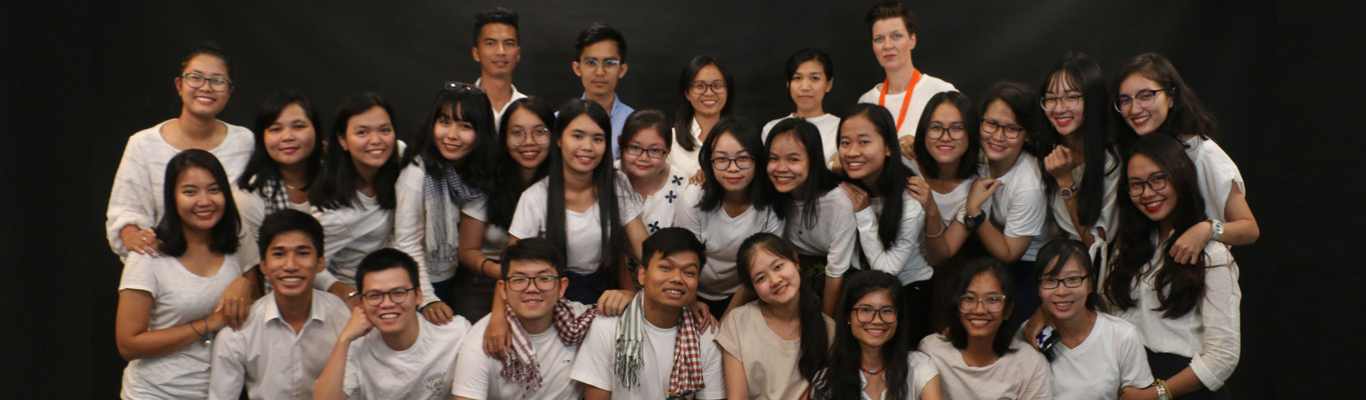
Batch 15 students, Department of Media and Communication (DMC)
Batch 16 students, Department of Media and Communication (DMC)
DMC Alumni
Multimedia Production Trainees
Print Design
Tith Chandara, Brother Branding Company
Kan Sopanha, Brother Branding Company
Ravy Sophearoth, students of Department of Media and Communication
Luīze Sniedze, exchange student from Rhine-Waal University of Applied Sciences
Artists
Keat Monnyrak, Kramuon Art Design and Mass Communication
Bun Somnang, Architect student from Royal University of Fine Arts
Ly Puthirak, Architect student from Royal University of Fine Arts
So Vitou, Architect graduate from Royal University of Fine Arts
Proofreader
Pa Chanroeun, Khmer Proofreader
Maria Montello, English Proofreader
Administrative Team
Kol Chanmakara, Department of Media and Communication (DMC)
Tech Many, Department of Media and Communication (DMC)
Mour Mengseng, Department of Media and Communication (DMC)
Acknowledgement
Documentation Center of Cambodia (DC-CAM)
Kdei Karuna Organization
Bophana Audiovisual Resource Center
Contact Us
Facebook page: Mapping Memories Cambodia
Address: DMC/CCI, RUPP, Toul Kork, Russian Blvd, Phnom Penh, 12156 Cambodia. Tel/Fax: (855) 23 88 44 08 l Email: cambodiammc@gmail.com
Welcome to Mapping Memories Cambodia
Mapping Memories Cambodia (MMC) is a mobile app and website that tells place-based stories from the Khmer Rouge era. The app marks significant places from that time on the Cambodian map, and guides users to where historical events happened. Users can read and listen to stories told by survivors, experts and historians in multimedia format. All stories are written and produced by the students of the Department of Media and Communication (DMC) of the Royal University of Phnom Penh (RUPP), and were factually verified by the Documentation Center of Cambodia (DC-CAM). For an overview and more detail on (scientific) Khmer Rouge History, please visit DC-Cam Khmer Rouge History website (Khmer) or DC-CAM website (English).
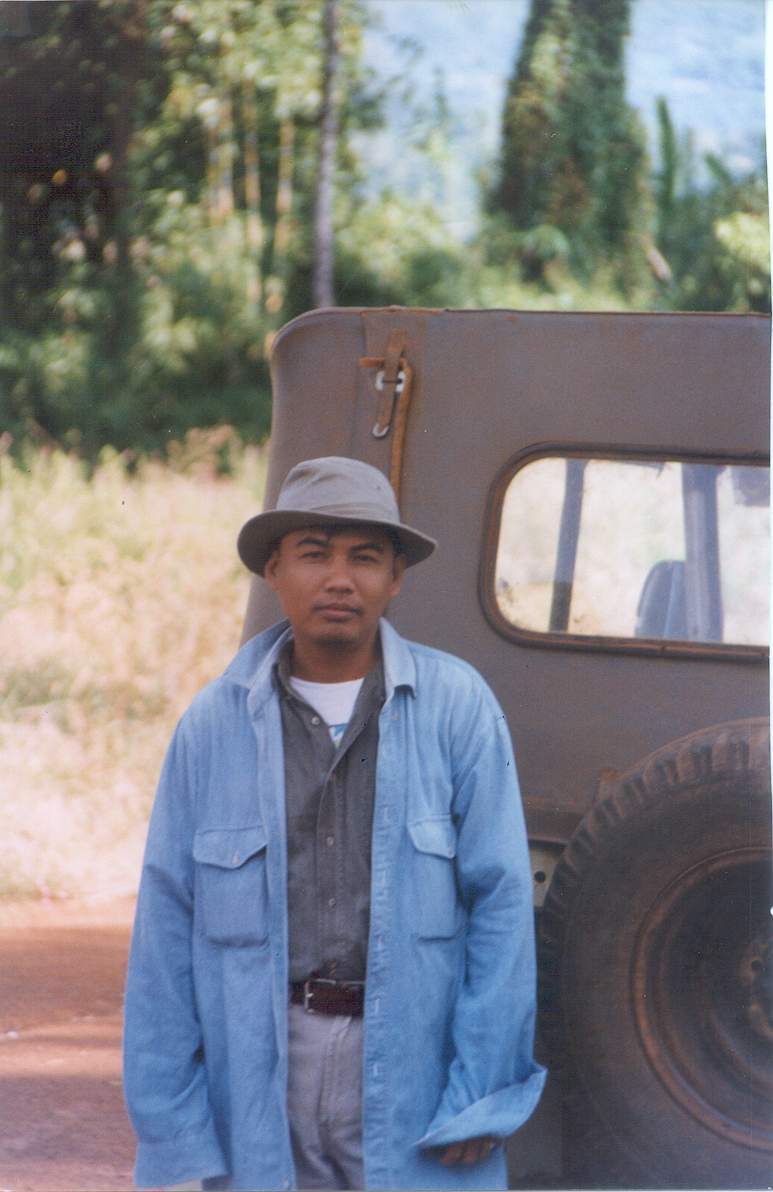
Youk Chhang on his trip to map the Khmer Rouge’s prison and killing fields in the Northeastern part of Cambodia in 1998. (DC-Cam Archives)
Grassroot and Technology
Sometimes there can be an unnecessary tension between grassroots actions and technology. Grassroots actions draw their strength from individuals, communities, and bottom-up arrangements of decision-making, action, and power.
Technology is not tied to a specific culture, organizational strategy, or arrangement of power. Technology is apolitical, amoral, and by definition, everchanging. Embracing the circumstance of constant technological innovation can be daunting for individuals, let alone organizations that are based in the most austere environments. It is difficult to embrace ever-changing technology in environments where habits of circumstance and mind have weathered the centuries and millennia.
Despite the difficulties, the Documentation Center of Cambodia (DC-Cam) believes grassroots actions need to embrace technology in order to survive and thrive—not only in Cambodia, but around the world.
Technology is a new world that is made for the younger generations in Cambodia. Technology can give people access to new information about the Khmer Rouge and most importantly empower them with an ability to question their contemporary circumstances and compare them with their past.
This project is a good first step in this endeavor to connect individuals and communities with Cambodia’s past. This project is not only an important tool for learning individual stories and collective history, but also empowering dialogue on important questions that continue to define Cambodian and post-conflict society development.
-
How does starvation, forced labor, murder, and atrocity transform societies and the individuals who survived?
-
What can people learn from the destruction of country, community and individuals?
-
How should the past inform our struggle with contemporary problems and future challenges?
-
How should victims be remembered, and how do we convey their experiences to the generations who never knew war, starvation, or atrocity?
-
How can we use technology to engage and empower individual and community action?
-
And, can a society create new ideals in the wake of genocide and mass atrocity?
This project is the beginning of an endeavor that needs the participation of Cambodians and the international community to succeed. As the Extraordinary Chambers in the Courts of Cambodia (ECCC) begins to wind down its cases, our struggle to understand and learn from the Khmer Rouge must not end. We bear a duty to the next generation. Our future depends on understanding our past. I encourage you to support this project through your participation and inputs. Together, we can make a difference.
Youk Chhang
Director Documentation Center of Cambodia
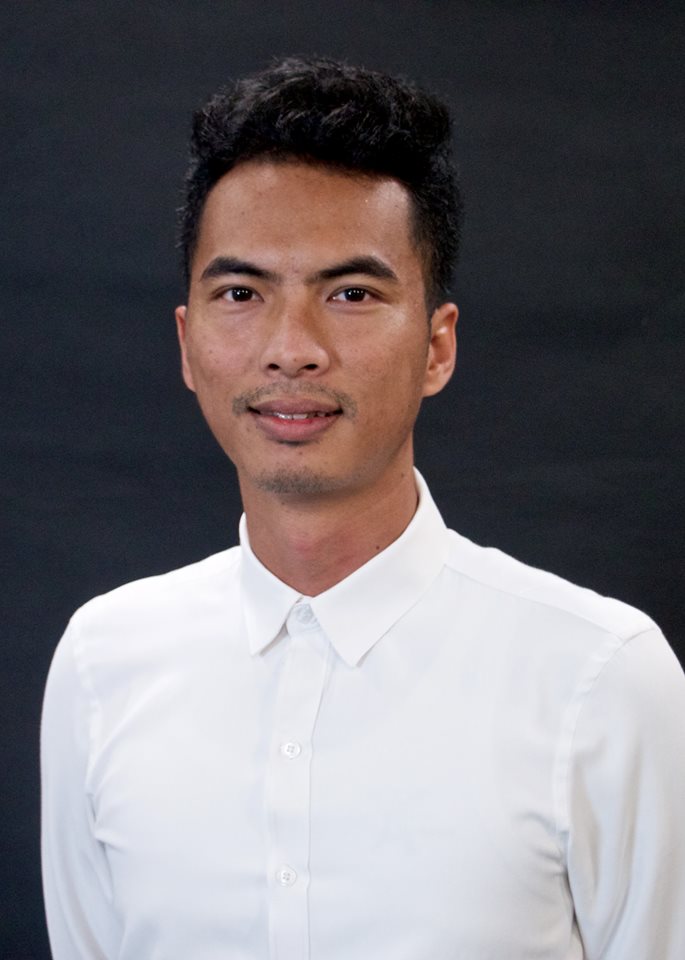
Ung Bun Y, Acting Head of DMC
Welcoming Message
Mapping Memories Cambodia (MMC) is another masterpiece of the Department of Media and Communication (DMC) of the Royal University of Phnom Penh (RUPP).
As a leading academic institution for media, communication, and journalism training in Cambodia, DMC has a strong commitment to the field of research and production in addition to in-class learning.
The MMC project is a worthy showcase of our students’ achievements. Through their efforts, they put the theories learned into practice under the supervision of their lecturers and the project’s editorial team. Within one year, stories related to the Khmer Rouge regime were carefully produced and presented in the form of text, images and video while using geolocation to place those elements. Through this, they have created a unique user experience. This multimedia application is accessible on two platforms: a mobile device and a website.
Khmer Rouge history is a recurring topic for our students during their academic years. The DMC considers it important to continue dialogue on Khmer Rouge history.
Many of the contemporary difficulties in Cambodian society are rooted in the destruction and suffering during the Khmer Rouge period. The young generation needs to learn Cambodia’s past to understand how history has shaped their contemporary existence. Dialogue is one of the important tools that helps the public learn and reconcile the past with the present.
We believe that access to information and stories about Khmer Rouge history is the foremost mechanism for this dialogue to take place.
As information requires distribution, we recognize the importance of technology today. Young Cambodians are well-equipped with internet access and the latest gadgets; therefore, we think that a web and mobile application is the most suitable and accessible media for them.
By presenting Khmer Rouge history in an easy-to-digest format, we hope to trigger and engage young audiences to question, learn, and discuss the darkest history of Cambodia, and ultimately commit to create a peaceful future.
The DMC would also like to thank student-reporters, producers, contributors and the MMC editorial team who put a great deal of effort to craft this informative website and mobile application.
This project would not be made possible without the financial support from the Civil Peace Service of GIZ, and invaluable support from MMC’s official partner—the Documentation Center of Cambodia (DC-CAM) headed by Mr. Youk Chhang, who worked to ensure that all content is factually correct.
The DMC hopes that this multimedia website and mobile application serve as an essential platform for meaningful and open dialogue about the Khmer Rouge history among the Cambodian young generation as well as across generations.
Ung Bun Y
Acting Director
Reconciliation and Technology
As Youk Chhang, rightly stated technology in itself is “apolitical, amoral and (…) ever changing”. We, as Civil Peace Service of GIZ, commissioned by our Federal Ministry for Economic Cooperation and Development (BMZ) use communication technology whenever it deems suitable to encourage reconciliation. Reconciliation can take place when those who have suffered and those who see their kin suffering can speak out and their needs are heard and met.
Technology has changed the way we communicate with each other: On the one hand, web-based communication technology opens space for people of every walk of society to connect to each other rather informal and, maybe, less committed. On the other hand, the people who share their suffering with people they will presumably never meet in person deserve our acknowledgment and due respect. To find the right balance between the new opportunities and the immanent challenges that is what we are here for together with our partners, friends and virtual communities. (Phnom Penh 14.11.2018)
Julia Ilse
Coordinator of the Civil Peace Service Program –
Justice and Reconciliation in the Context of the Khmer Rouge Tribunal – (ZFD-GIZ)